Monday, August 4, 2014

The Last Place on Earth or "I hear bangoes" - Camping Log Entry 4


2010, the first year that I took my husband camping in the UP, I was on a quest to find every waterfall which I could. In the Gazetteer, I found the Upper and Lower Gratiot Falls. Granted they appeared to be in the middle of nowhere. But really? Isn’t that the entire UP? We didn’t have any luck that year.

This year, as we were heading back to our campground, driving along Five Mile Point Road, I spied a sign for Gratiot River County Park. I thought, ah, ha, maybe this would take us to the elusive falls. We started down the gravel road and our teeth quickly began to rattle in our heads. The road was wide and straight but was in desperate need of grading. And then it deteriorated.   

The road narrowed and began to wind through the woods. We met a Jeep coming out, so surmised that at least the road went somewhere. We continued to crawl along at a top speed of 20 mph, the poor Blazer just rattling from its every joint. In the rearview mirror, the hubby could see a car coming up behind us, going probably 35 mph. The hubby pulled over and the car whooshed past.

“Hmm? What do you suppose is at the end of this road that they were in such a hurry to get to?”

“I don’t know,” the hubby answered, “but I can’t believe how fast they were going. This-road-is-awful.” The corduroy road was rattling his head again.

Then we came upon this sign. I cannot say who this fellow is, but I would be embarrassed to have this road named after me.

 After what seemed like an eternity, we rounded a curve and saw vehicles parked up ahead, beyond which lay Lake Superior in its usual shroud of mystery. There were about eight vehicles scattered around the dusty parking area. The hubby chose to turn around and park on the side of the road, heading out, for a quick exit. 

 As we climbed from the Blazer, he asked, “Do you hear banjoes?”

“What? Stop with the overactive imagination.”

Never the less, he kept Dino on a short leash.

As the road opened out onto Lake Superior, we saw a tattooed and toothless man carrying a fishing pole, the sleeves of his shirt cut off. A whale-sized woman, wearing a black bikini, waded in Lake Superior. Another woman with her man were drinking beer and playing cards on some pieces of driftwood. Some children played, but I didn’t hear them laughing. I didn’t hear any human sounds actually, just the sound of the waves on the beach. Clouds had overtaken the sun.


I trudged through the sand making the most of the long drive out here. I could sense the hubby behind me, the dog tight to his side; they weren’t going to follow me.

I snapped a few quick pictures, and to the hubby’s great relief, turned back. He was already hustling back to our vehicle. He had the engine running by the time I joined him just moments later.

“Just let me get a few more pictures,” I whined.

“But I tell you, I hear banjoes!”

“Oh, stop it, already.”

“No, really,” he argued. “I think they are just waiting for a sacrifice to show up.”

Just then a large motor home drove around the corner in front of us. “Are you kidding me?”

“See, I told you. The sacrifices have arrived.”

Yup and about that time, I started hearing banjoes.


(If you’ve never seen the movie “Deliverance”, you won’t get the banjoes reference, but you can look it up here.)

Sunday, August 3, 2014

Service to the Lord - Camping Log Entry 3

They devoted themselves to the apostles’ teaching and to fellowship, to the breaking of bread and to prayer. Everyone was filled with awe at the many wonders and signs performed by the apostles. All the believers were together and had everything in common. They sold property and possessions to give to anyone who had need. Every day they continued to meet together in the temple courts. They broke bread in their homes and ate together with glad and sincere hearts, praising God and enjoying the favor of all the people. And the Lord added to their number daily those who were being saved.
Acts 2:42-47 New International Version

If you are ever in the far reaches of Michigan’s Upper Peninsula, take Hwy 26 north out of Phoenix, until you find Jacob’s Falls. Go another hundred feet or so and stop in at this place.

 I know that I have blogged about this wonderful little bakery before, but I just have to give them as much free press as I can. Here is who they are, according to their website:

We are a Catholic Monastery of the Byzantine rite, under the jurisdiction of The Ukrainian Catholic Eparchy of St. Nicholas in Chicago, and belonging to the Ukrainian Metropoly in the United States of America, which is in union with the Pope of Rome, supreme pastor of the universal Church. We embrace evangelical poverty, chastity, obedience, and stability of life, according to the Rule of Saint Benedict and the traditions of the Christian East.

I always thought that monks lived a simple life. That description does not sound so simple. These monks at Jampot, however, go on to share that:

In our skete at Jacob's Falls, on the shore of Lake Superior in Michigan's Keweenaw Peninsula, we devote ourselves to a common life of prayer and work for the praise, love, and service of God and for the upbuilding of His Kingdom through the Arts.

That should be everyone’s goal – to live a life of prayer and work in the service of the Lord. Further, we should serve all others and share with them the love of Jesus Christ.


Oh, and if you are wondering just what a skete is, it is the happy medium between the kind of monks who live as hermits on a mountaintop in the middle of nowhere and those who live a 100% communal life surrounded by and sharing everything with their partner monks. 
And don't mess with these monks and break the eleventh commandment. Keep them happy so they keep baking. 

Wednesday, July 30, 2014

Ghosts of Mining Past - Camping Log Day 2

Over the years, I have been fascinated by the waterfalls and cemeteries of the Keweenaw Peninsula –the very top of Michigan’s UP. In the past, I have visited and photographed as many waterfalls and cemeteries as I could find.  Who doesn’t love a good waterfall – the water spilling over rocks and through crevasses? And you already know my fascination with all cemeteries, but put me in the midst of old decaying headstones and my imagination really takes off.

Yet there is one more aspect of the Keweenaw (pronounced kee-wa-nah, by the way) to be explored. The mining ghost town. 

One of the most noteworthy historical sites in Keweenaw County is Central, or Central Mine, a village whose population was once over 1,200 people. One the area’s most successful copper mines, mining began here in 1856. The mine's lode proved so rich that Central was able to turn a profit in its first year of operation and by the time it closed in 1898, the Mine had produced nearly 52 million pounds of copper.


The town was located in an ancient mining pit along an outcrop below a Greenstone Bluff and boasted over 130 structures, including mine buildings, homes, schools, businesses and the Central Methodist Church. In 1898 the mine ceased operation, and residents began leaving the town.


Several miners' homes and buildings still stand on the site. In 1996, the Keweenaw County Historical Society acquired 38 acres of the old Central site. Some of the residences are being restored, and a Visitors Center provides interpretive exhibits not only about the mine but also about the miners' families, homes, schools and churches.


Construction of the Central Methodist Church began in 1868. When it was occupied the following year, it became the major focal point of religious and social life in the community for all who were members of it and for many who were not. It was inevitable that there should be a close feeling among the former residents of Central, who were forced to relocate to other parts of the area following the closing of the mine in 1898. The opening of the Keweenaw Central Railroad in January, 1907, provided an opportunity for the old-timers to have a "homecoming." The last Sunday of every July since then, the church has been host to a reunion of descendants of the residents of Central as well as those with an interest in a time gone by. 


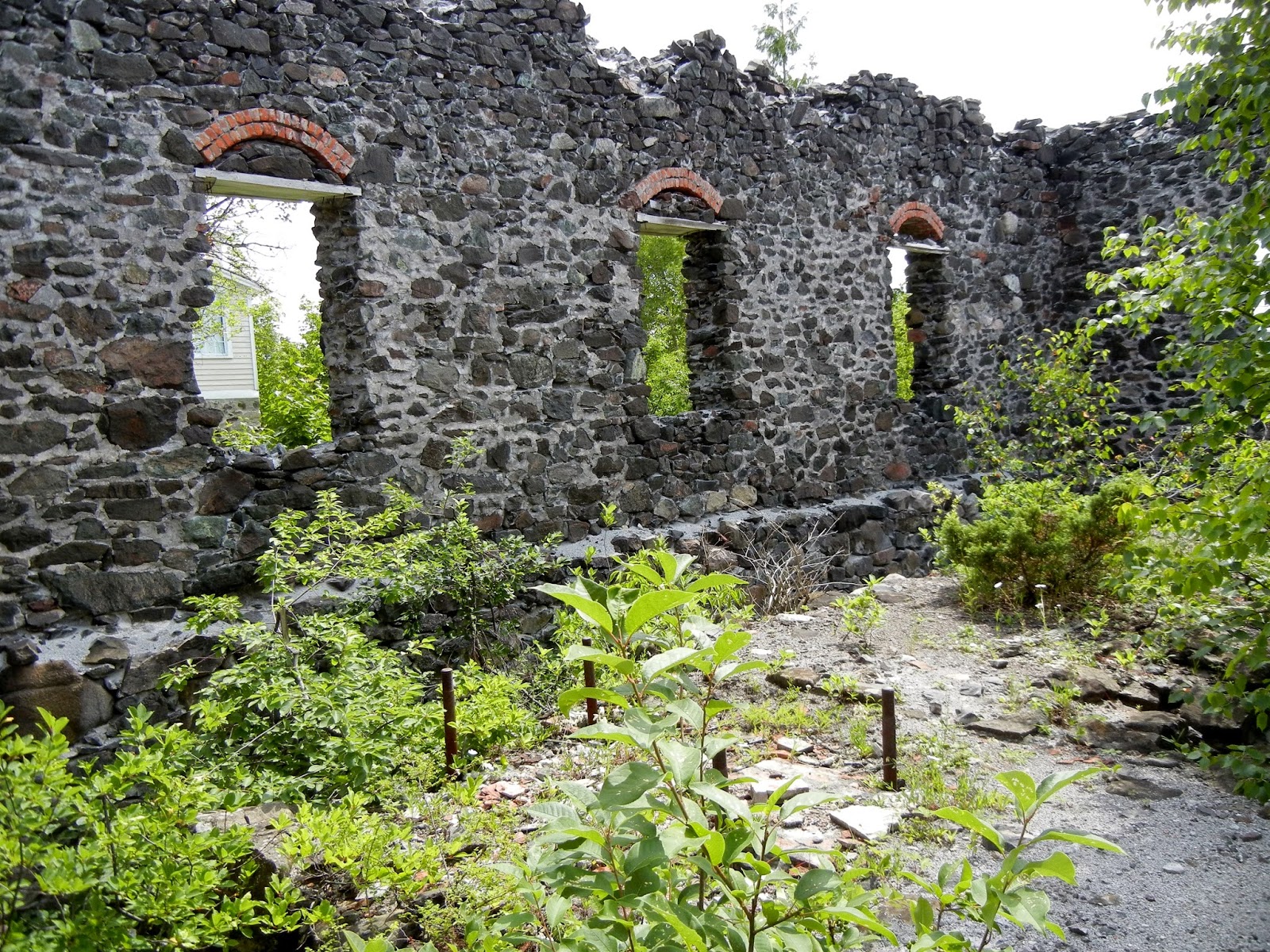
This is the site of the old schoolhouse. 
Mining - an occupation filled with danger. 
 

Monday, July 28, 2014

What's in a name? Camping Log Day 1

On Saturday, we returned from another awesome camping trip at F.J. McLain State Park eight miles north of Hancock, Michigan. I have blogged about this place enough before. I’ve shared enough pictures before as well. You still get a few more pictures.
Campsite is set up and Dino is starting to settle in.
A fort some kids had fun building on the beach. 
I can't tell if the camp store is open or closed, but at least they directed me to the door. 
I always wondered where the name came from. Who was F. J. McLain and why does he have a park in the Upper Peninsula named after him? I thought a quick internet search after I got home would answer my question, but I was out of luck. I could have asked about it up at the Park, but I bet no one there knows either.

I looked into other Michigan state parks and discovered that Van Riper Park was named after Dr. Paul Van Riper who practiced medicine in that area for most of his 91 years and was involved in local politics.  J. W. Wells State Park was established in 1925 when the children of John Walter Wells made a donation to the state. Mr. Wells had been a pioneer lumberman and mayor of a nearby town starting in 1893. 

But nothing on F.J. McLain until my hubby got home from town. When I mentioned this to him, he quickly answered, “But didn’t you read the sign?”

“What sign?”

“I can’t remember where it was, but I saw a sign that talked about a McLain.”


Really? You know what that means, don’t you? We'll just have to go back to the UP and find this sign.
Sunrise
Sunset. And sometimes that's all you get. But it is good enough for me. 

Wednesday, July 23, 2014

Walking the Streets of Hatchet Creek - Day 7

I am cheating here a little bit.  Last week, when I visited the historicalmuseum in my town and then blogged about it – well, I did walk a few streets that day as well. 
 Tomahawk’s first church is the First Congregational Church built in 1887 on the corner of Washington Avenue and 5th Street.

 When the old clinic and hospital moved to its new location on Mohawk Drive, both those buildings went up for sale. Anyone who has been following any Tomahawk news knows the fate of the old hospital. The clinic luckily went to better use. It was extensively renovated to become the new St. Mary’s School.

 Neat fountain outside of the school.  (Oh, and by the way, there hasn’t been much activity on the outside of the old hospital, but I will post pictures as soon as something starts happening that I can see from the street.)
 Location of the old St. Mary’s School.

 St. Mary’s Catholic Church.
And just a block over, the Harley Davidson Plant on Somo Avenue. Quite a bit to see within just a few blocks.
What I've walked previously in green, what I walked this time in blue. I still have a lot to go, and this is just the main part of town. I need to cover the "suburbs" too!

Monday, July 21, 2014

The Boy at the Museum

I am not a fan of television, and I abhor one particular genre of television programming - reality TV. As if, I ask myself, any of those shows depict the real lives of their characters. If this is true, I have a great deal of sympathy for these people. So why the immense popularity with reality TV? It is human nature to be drawn into other people's problems, to witness their downfalls, even to marvel at their greatest flaws. And this is nothing new.

How did Ripley's Believe It or Not come about? Why were the carnival side shows so popular a hundred years ago? We are fascinated by the dark side of humanity. Such is the premise of “The Boy at the Museum” by Tamera Lenz Muente.


An eight-year-old boy becomes an attraction at a Cincinnati museum in 1843 simply because he was born without legs. The story is told by his mother Elizabeth and by Arthur Watson, a young man desperate for a job in the big city, who gets pulled into the macabre world of the museum by becoming a sort of nanny to the boy. As any eight-year-old boy would be, Enos is just as curious about the museum as its visitors are about him.

In addition to following the antics of young Enos, we follow the stories of his mother and his caretaker Arthur. We root for them and hope that good conquers all in a place where darkness seems to prevail. Told in the first person by both Elizabeth and Arthur, at times, I became confused as to who was telling their story.

Overall, though, the author has done a great job creating an America of the past, one that we don’t usually hear about. “The Boy at the Museum” is a great story and reminds us that we haven’t come so far in 170 years.   

Sunday, July 20, 2014

It's ok to bend.

 Some people refuse to bend when someone corrects them. Eventually they will break, and there will be no one to repair the damage. Proverbs 29:1 Easy-to-Read Version

I’m reading “Years of Stone” by Beth Camp and the male protagonist is serving a seven year prison sentence. It is the 1840s and he has been shipped to Tasmania to serve out his time, so you can imagine what the conditions are like. Being the noble hero that he is, whenever he is confronted with injustice, he is compelled to fight back. But instead he controls his instinct by telling himself, “Bend, don’t break.”

When we are faced with trials, our first reaction is to react, whether that means we adamantly disagree, blatantly argue or simply dig in our heels until we get our own way. So what does it mean to bend instead? Let the other person get what they want. Do what you are told to do no matter how badly you don’t want to or even know that it isn’t the best thing to do. Turn the other cheek. Ask yourself, “what would Jesus do?”

Ask yourself “is this doing harm to another person? Does this go against my beliefs in God? Is this going to matter years from now?” Bend when you need to, just don’t break.


Lord, God, help me to make the right decisions. Give me strength to stand up when I need to and grant me peace when it is best to sit it out. Amen

Outside the prison in Ayacucho, Peru, the only prison I have been inside. Was never so relieved to walk out of a building as I was that day. It does put a whole new perspective on the importance of making the right decisions.