| One of the many churches I saw in Ayacucho, Peru. Which bell was the Kartoffelglock? Or would it be cuy campana? |
This blog is named after my dog, Dino the wonder dog. Other than that, this blog doesn’t have a lot to do with him, except that some days, when I am just too busy or too tired or have a migraine, I let Dino write my blog for me. On days when he has not taken over the computer, I write about my life – the past, the present and the future - my travels far and near and my home. I would love it if you would follow along.
Sunday, October 20, 2013
"Every time a bell rings . . . "
Sunday, February 10, 2013
Where does your help come from?
![]() |
| Flying over the Andes Mountains in Peru. |
Thursday, February 23, 2012
We are children
Like a bird in the wind, like a tree in the storm
Like the breath of a child from the moment he’s born
To the very last day when the curtains are drawn
We are children of the world. By The BeeGees
The children from the prison in Ayacucho, Peru. Yes, they live in the prison with their mothers who are inmates. But the thing that always amazes me about kids is that they don't know any better. They think the prison - or whatever sad abode they call home - is the greatest place to live. God probably made little boys and girls that way on purpose.
Friday, August 19, 2011
Last Chance to see Peru
Our plane left Ayacucho at five am on Saturday. We arrived in Lima without incident, to face the 12 hour layover. Tina, luckily, had already reserved a room at the Marriott and was kind enough to let Gayle, Meg and I join her. Meg was feeling under the weather, so crawled into bed, while the rest of us secured a tour of the city. Lots to see, lots of history. Lots of old buildings and bridges and statues, but a lot of the areas were as modern as any big city in the world.
Wednesday, August 17, 2011
Going to Prison

So, imagine this. You are in a foreign country where you don’t speak the language. You are with eight other people, who you feel you can trust, but you only met them five days ago. You are all led into a dank cement block room, a thick metal door clanks shut behind you. A female guard pats you down and stamps your arm. Then another guard takes your passport and puts another stamp on your arm.
You walk through a room with shower heads on wall – where the inmates are no doubt strip-searched and showered before they are incarcerated. Another metal door clangs shut.
Your group walks up a flight of metal stairs and you stiffly walk across a wide balcony. Below you, in an outdoor courtyard, male inmates are watching. A few shout up to you and for once you are happy you don’t know the language.
You enter a dark hallway, trying like everything to slow your breathing.
Then suddenly you are out a door and an almost surrealistic scene greets you. A few dozen women are mingling in an open air court, cement walls, two stories tall, on all four sides. The women are hanging up laundry, sewing and working on crafts. They laugh and most of them don’t even look up at you. The ones who do look up at you are the children, all under age five. They come running up to you and a few of them start playing with Henry, Angelina and Harrietta, the volunteers who have all been here before.
Tina, Meg, Gayle and I just look at each other. This is as far out of our comfort zone as we ever imagined we would be.
It was the last full day of my volunteer trip to Ayacucho, Peru, in 2009, and we have arrived at the prison to take eight of the boys and girls out for the morning.
Up until age five, they allow the children to live in the prison, in their mothers’ cells with them. That is rather sad; what kind of life is that for these little ones. The truly sad part though is that someone decided that when they turn five years old, prison life is no longer right for them, or they are old enough to live without their mothers. So these kids are taken out of the prison, perhaps the only home they’ve ever known, and given to relatives to live with or if there are no relatives who will take them in, they go to the orphanage until their mothers are released.

To break up their routine, we each were assigned one child, we loaded them into the bus with us, and drove back to the Plaza. They chased pigeons and ate popsicles, and at least for a short time acted like they led normal lives.
When we brought them back to the prison and all the kids were accounted for, our passports were returned to us. And one final note. If you are wondering what the women are in prison for, most of them were charged with running drugs, one of the most lucrative occupations in Peru.
Monday, August 15, 2011
Scenes from the roof
The house we stayed in while I was volunteering in Ayacucho had a wonderful rooftop patio. I spent a lot of time up there, either visiting with the other volunteers or writing or just enjoying the southern hemisphere fall weather. I could never get a sense of direction though; the sun being to my north just threw me way off. The views, if I looked straight out were fantastic. If I looked down, though, not so good.
View from the roof facing in another direction
View out the living room window, zoomed in on the guinea pig farm on the neighbor's roof

In Peru, they call it Cuy (pronounced kwee). Some of the other volunteers I was with just called it, "no way am I eating that." I guess having lived in the Northwoods my whole life, I have eaten enough wild game that a little guinea pig wasn't going to faze me. One of the gals I was with thought it tasted "gamey". Obviously she has never eaten bear meat or turtle. I thought the guinea pig tasted like – well, not quite like chicken, maybe partridge.
Saturday, August 13, 2011
Creating
For the past two weeks, I have been writing about the volunteer trip that I took to Ayacucho, Peru, in 2009. I had a particular inspiring thought to write about this weekend to tie into that trip. Then it dawned on me that I have a table at a craft show this weekend and I am going to peddle my blog site, along with my sewn creations. Perhaps, on the off chance that anyone who visited my craft booth actually goes to my blog when they get home, I should really get those creative juices flowing and tie this weekend’s inspiration to both Ayacucho and the craft show. So, here it goes.

Whenever anyone travels to a foreign country, the inclination is to go crazy buying souvenirs. I really tried to control myself when I was in Peru, but I kept thinking of people that I had to buy for or I would find something that was just too cute to pass up. To make the temptation even greater, every day, on our walk to the Plaza, we passed this great artisan’s market, and every day I had to go in and wander around some more.
This market was built inside the city’s old prison. Each of the cells was now a booth for a vendor. It was way cool; I wish I would have taken pictures of the inside instead of just the outside. Some of the homemade crafts were beautiful. There was lots of jewelry and tapestries and pottery, like the figurines from Quinua, and everything was reasonably price (hence further temptation to buy).
Most of these vendors make their living on whatever they can sell in the market. Unlike me, who just wants to sell my goods to break even and get it out of the house.
But I think we all have a compulsion to create, whether it is quilts or clothes or necklaces or stained glass or photographs or baked bread or casseroles. Even in our daily work we are creating, whether we are working in a factory making something tangible or we are offering our services. Doctors create good health, counselors create peace of mind, the cable guy creates good television reception, a stay-at-home mom creates a loving environment for her family.
Maybe this desire to create is because we are made in the image of the ultimate Creator. With loving hands, God made each of us out of nothing, so that we can create the work he has planned for us.
For we are God’s handiwork, created in Christ Jesus to do good works, which God prepared in advance for us to do. Ephesians 2:10 New International Version
Friday, August 12, 2011
The Tarnished Path
I hate it that I never followed the news. When I was growing up and even when I was in college – when I should have cared a little bit – things were going on all over the world which barely made a dent in the grey matter of my brain. Even today I don’t follow the news like I should; I guess because it is all rather depressing.
Back in the late 1970s, in central Peru, a professor by the name of Abimael Guzman organized a group called the Shining Path and tried to take over the government. Into the 1980’s his followers destroyed or bombed buildings and murdered many innocent people. When the government stepped in to put an end to things, many more people were murdered, whether followers of the Shining Path movement or not. In total over 50,000 Peruvians died.
I think I may have heard about it on the news, but it didn’t make much of an impression.
Ayacucho, Peru, was one of the hubs of activity at that time. When I volunteered there in 2009, we toured the Museo de la Memoria and learned about this dark time in Peru’s past. Marisol, the young woman who worked at Cross Cultural Solutions in Ayacucho, had been a young girl at the time and shared with us some of the horrors of the 12-year stretch that Guzman’s followers terrorized the country. She remembers being in class and men dressed in army gear would come into the room and randomly call kids out. She never saw those classmates again.
And I know the same kind of stuff has been happening around the world for years and years. When are we going to learn? When is it going to stop?

Wednesday, August 10, 2011
The Orphanage
On Thursday, while I was volunteering in Ayacucho, Peru, with Cross Cultural Solutions, we went to the orphanage. After that day, we decided that the organizers of our stay started us with the easier placements and worked up to the hardest ones. The first of the week wasn’t too bad, but by Thursday, we were feeling more stressed and challenged. Meg, Tina, Gayle and I became nervous for Friday, our last day there. How could it be more stressful than an orphanage of 150 boys and girls, some orphans but some just dropped there by parents who couldn’t afford to raise them.
We worked with the infants and toddlers. The youngest baby, a month old, had lost his mom and been brought to the orphanage when we was five days old. The infants went down for their naps around ten. The one year olds were not so lucky.
They were fun, a little sassy with each other, demanding our attention and not sharing their limited toys very readily. But by eleven, a few of them were getting sleepy, and the woman who worked there let us know that they were not to nap. Though we didn’t speak Spanish well enough to understand her, her gestures clearly told us that the toddlers had to stay awake. She even took one to the sink and splashed water on his face. It was heart-breaking.
Close to noon, another woman came in and they started taking the little ones, two by two, to feed them lunch. After they ate, they went down for their naps, whether they were tired or overtired. And, in somewhat of a daze, the four of us wandered downstairs to wait for the bus to pick us up.
Meg and I surrounded by the orphans and their toys. The window was their own contact with the outdoors. They loved it when we held them up to the window so they could watch the world go by.Monday, August 8, 2011
There's more than Incan Ruins out there
Saturday, August 6, 2011
Need some good luck?

The beautiful village of Quinua, an hour’s drive from Ayacucho, Peru, is known for its pottery.

One of the specific types of pottery that is especially popular are figures of houses and churches. The tradition is to place these on the roofs of homes and other buildings for protection. They are supposed to bring good luck to those inside. Even the church in Quinua had these cute replicas on its roof.

Now, I may be wrong here, please let me know. I certainly understand that everybody needs good luck; I know that I sure do. But instead of counting on an inanimate object to supply that luck shouldn’t I be praying to God instead. If I think that putting something on my roof is going to help me out, isn’t that idol worship? I shouldn’t be turning my attention to a cold piece of pottery. Instead, I need to turn my eyes to my Lord and Savior.
So be careful not to commit the sin of worshiping idols. Don't make idols to be worshiped, whether they are shaped like men, women, animals, birds, reptiles, or fish. And when you see the sun or moon or stars, don't be tempted to bow down and worship them. The LORD put them there for all the other nations to worship. But you are the LORD's people. Deuteronomy 4:15-20 (Contemporary English Version)
Thursday, August 4, 2011
Quaint Quinua
On Wednesday afternoon, while I was in Peru in 2009, Rudy, the director of CCS in Ayacucho, took us for a ride into the Andes Mountains and the small town of Quinua. Quinua is an absolutely adorable little town, right on the edge of the cocaine trade. That just doesn’t seem right, does it?
Monday, August 1, 2011
A Look at the Clinic
When I first signed up to go to Peru with Cross Cultural Solutions in 2009 and they asked if I had any special areas of interest, I told them that I worked in a clinic, so would like to experience their health care. On Wednesday, I had that opportunity.
Angelina, one of the students who was staying in Ayacucho for several months, took me to the clinic that day and showed me around. Wow, it was a hodge-podge of buildings and rooms, all run fairly efficiently it appeared, but just very different from back home.


Sunday, July 31, 2011
Look to the Cross
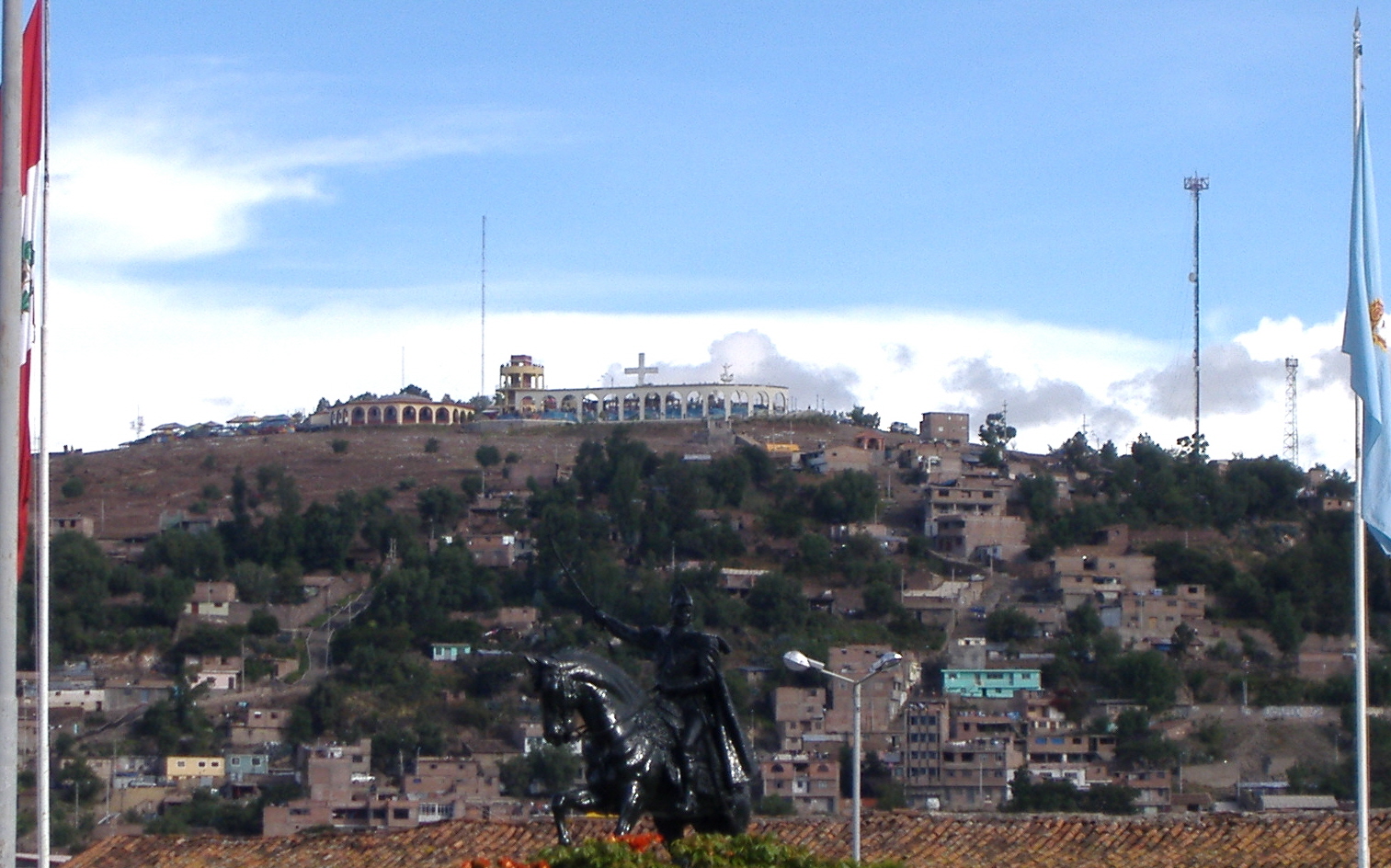
Rudy, our host at the CCS office in Ayacucho, Peru, where I volunteered in 2009, explained that many cities in Peru (perhaps throughout South America and even the world for all I know) will have a cross placed on a hill high above the city. Being a predominantly Catholic nation, people in Peru will look to the cross for strength and support.
Isn’t that something that everyone should get into the habit of doing? Whether you have a cross above your city, one hanging on the wall in your house or only the vision of a cross you carry in your head and your heart, look to the cross and remember what it means.
It means that our loving Father in heaven sent His Son to die on that cross so that we don’t have to. No matter what we are facing today, turn towards the cross and turn towards our Savior.
As for me, may I never boast about anything except the cross of our Lord Jesus Christ. Because of that cross, my interest in this world has been crucified, and the world’s interest in me has also died. Galatians 6:14 New Living Translation (NLT)


Friday, July 29, 2011
The Street Children
Tuesday morning of my stay in Ayacucho the placement where we worked was called the street children. Not the most appropriate name, I thought, but that’s what CCS called it and I couldn’t come up with anything better.
Adjacent to one of the city’s huge farmers’ markets, there is a simple building set up as a sort of drop-off center for kids whose parents are working in the market. The boys and girls go to work in the morning with their parents, work at their stall for a while, and then when they need a break, they walk over to the center to hang out, play with other kids or work on their homework. A lot of the schools were on break due to the Semana Santa (Easter) celebrations, so there were more kids at the center than usual.
Tina, Meg, Gayle and I brought out a deck of Uno cards and played game after game with the youngsters. It helped us all learn our numbers and colors, I’ll tell you that. We also drew pictures with them and they would point to the pictures and tell us the name in Spanish.
Just as we were leaving for the morning, two little girls, ages six and seven, came walking in. They were so adorable, just beautiful lambs and so friendly and happy. They hugged us foreigners as if we were all old friends. When we left the center, we walked through the market place to see what it was like and ran into the two little lambs at their father’s stall. And got more hugs.
It was a happy morning, filled with lots of laughter and silliness.
Wednesday, July 27, 2011
A tour of Ayacucho
Cross Cultural Solutions, the organization I traveled to Peru with in 2009, set up most volunteer placements so that you worked in the mornings and in the afternoon you learned about the culture of the country. The first afternoon following our first placement, Rudy, the director of the Ayacucho location, took us on a tour of the city. Just a breathtakingly beautiful city. In these pictures anyway. Not all views looked like this, as I will share in upcoming days.

Monday, July 25, 2011
A nursing home is still a nursing home
Cross Cultural Solutions, the organization that I traveled to Peru with in 2009, offers several different volunteer options, ranging in duration from one week up to three months. Volunteers who are staying for a longer period of time are assigned to an area in which they are interested and their daily volunteer work concentrates on that, such as health care or teaching. Since our little group of four was only staying for one week we had the unique opportunity to experience a little bit of everything, by going to a different volunteer placement each day.

Our first day, we were assigned to the nursing home. It was a clean and efficient facility, men and women on completely separate wings. We worked on the women’s wing and when we arrived, they were all dressed and out in the courtyard for the morning. Just like the nursing homes back home, they were pretty much left to themselves until lunch. And if we hadn’t been there to try to entertain them, well, they would have had no entertainment. We played catch with them, colored with them and even danced with a few who were agile enough. One little lamb, carrying a plastic bag full of her stuff, told the staff worker who had brought us from our home base that she was waiting for the bus to take her to Lima. Sounded just like some of the nursing home residents I know.

Sunday, July 24, 2011
Ayacucho, Peru, high in the Andes Mountains, is known as the city of churches. It is said that there are 33 churches in this town, one for each year of Christ’s life. Odd that no one seems to know exactly how many churches there are. Is that because no one knows exactly how to define a church? Does it have to have an active congregation with regular services? Does it have to have a certain architecture, does it have to “look” like a church?
Actually, as cool as these old buildings are, they are just buildings. A church may be just a building, but The Church is what is important. The Church can be anywhere, anywhere that believers are gathered. The Church is what we each carry with us in our daily lives. For you see, The Church is the Body of Christ.
And the church is his body; it is made full and complete by Christ, who fills all things everywhere with himself. Ephesians 1:23New Living Translation

