Showing posts with label World War II. Show all posts

Tuesday, March 4, 2025

What Is Freedom?

     Near Sauk City, Wisconsin, are the grounds of the former Badger Ammunition Plant, which I blogged about after visiting it a few years ago. I ran across this post the other day and thought it was worth reposting. 

Inside the Badger Army Ammunition Museum, I found the following poem, hanging on one of the walls. I tried searching for it on the internet, but came up empty. I hate reprinting articles without giving proper credit, but all I can say is that at the end was a blurb that it was used by permission of the Louisville Journal-Courier, as shown in the second picture. Hope that gets me out of plagiarism charges. In any case, I love this poem and am willing to risk arrest, because, well – that’s what freedom is. Don't take it for granted; we all need to keep fighting for our freedom.  

What is Freedom?

From the archivea of broken peace we are bringing out old words and dusting them off for use again, as shining lanterns to lead us through the darkness of another war.

Words like freedom, justice and truth – all of them hard to define, none of them used more frequently than freedom.

You cannot say what freedom is, perhaps, in a single sentence. It is not necessary to define it. It is enough to point to it.

Freedom is a man lifting a gate latch at dusk and sitting for a while on the porch, smoking his pipe, before he goes to bed.

It is the violence of an argument outside an election poll, it is the righteous anger of the pulpits.

It is the warm laughter of a girl on a park bench.

It is the rush of a train over the continent and the unafraid faces of people looking out the windows.

It is all the howdys in the world, and all the hellos.

It is Westbrook Pegler telling Roosevelt how to raise his children; it is Roosevelt letting them raise themselves.

It is Lindbergh’s appeasing voice raised above a thousand hisses.

It is Dorothy Thompson asking for war; it is Gen. Hugh S. Johnson asking her to keep quiet.

It is you trying to remember the words to The Star-Spangled Banner.

It is the sea breaking on wide sands somewhere and the shoulders of a mountain supporting the sky.

It is the air you fill your lungs with and the dirt that is your garden.

It is a man cussing all cops.

It is the absence of apprehension at the sound of approaching footsteps outside your closed door.

It is your hot resentment of intrigue, the tilt of your chin and the tightening of your lips sometimes.

It is all the things you do and want to keep on doing.

It is all the things you feel and cannot help feeling.

Freedom – it is you.


 The website for the Ammunition Plant is: http://www.badgerordnancehistory.org/

 Here is background information on the names mentioned.

Westbrook Pegler was a columnist in the 1930s and 1940s, who opposed the New Deal and criticized the Supreme Court, the tax system, and labor unions. Pegler initially supported President Franklin Delano Roosevelt, but soon became one of Roosevelt’s sharpest critics, feeling the president was abusing his power. The journalist also had a strong dislike for Eleanor Roosevelt. In general, everything I read about Westbrook Pegler made me consider him to be the writer’s version of a loud-mouthed jerk.

Franklin Delano Roosevelt and his wife Eleanor had five sons and a daughter, although one son died in infancy. He was not very involved in raising his children, as he was so occupied with his work. He also believed that childrearing was a wife's task, but that was a common view in the early nineteen-hundreds. No matter what Pegler’s opinion was of the Roosevelt children, they turned out just fine.

Lindbergh refers to Charles Lindbergh, of course. Prior to the bombing of Pearl Harbor, he had been opposed to the United States getting involved in World War II. One of his journal entries at the time stated: "it seems improbable that we could win a war in Europe.” He also seemed to have a dislike, or maybe more a distrust, of President Roosevelt. After the bombing of Pearl Harbor, however, and our declaration of war, he joined the fight in the Pacific.

Dorothy Thompson was an American journalist and radio broadcaster. She had been working as a journalist in Europe, when in the late 1920s, the New York Post appointed her head of its Berlin bureau in Germany. There she witnessed firsthand the rise of the Nazi party and in 1931, she interviewed Adolf Hitler, writing the book, “I Saw Hitler”. She wrote about the dangers of him winning power in Germany. The Nazis considered both the book and her articles offensive and, in August 1934, Thompson was kicked out of Germany.

General Hugh S. Johnson was a U.S. Army officer, businessman, speech writer, government official and newspaper columnist. He is best known as a member of the Brain Trust of Franklin D. Roosevelt from 1932–34, writing numerous speeches for FDR and helping plan the New Deal. FDR fired him, however in 1934, for having Fascist inclinations. As World War II began raging, Johnson endorsed isolationism—staying out of the conflict. In a story he had written previously in 1911, he had Japan invading and conquering California.

Friday, March 18, 2022

BOW Wow (which is not about dogs), Wisconsin Dells, Post # 4

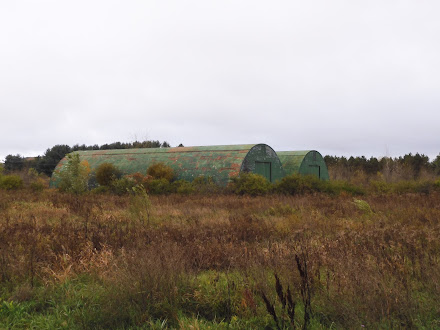
   On Wisconsin Hwy 12, seven and a half miles north of Prairie Du Sac or eight and a half miles south of Baraboo, is the Museum of Badger Army Ammunition.

In October of 1941, newspapers around the area announced that a Powder Plant would be built. Over 10,000 acres of prime farmland would be acquired by the Federal Government, land which included 74 farms, 3 schools, 3 churches, and 3 cemeteries. All those families were displaced.

The site was originally called the Badger Ordnance Works or B.O.W., but eventually became the Badger Army Ammunition Plant. When Pearl Harbor was attacked in December of that year, construction began in earnest on the largest propellent factory in the world.

It operated during World War II, the Korean War, and the Vietnam War, after which, it remained in a state of readiness until 1998. Shortly after that, the long process of deconstructing the plant began.

It took only seven months to build the massive operation on 7,400 acres, consisting of 1,400 buildings. Yet it would take ten years for most of that to be cleaned up. 


The land has been divided into three sections. 3,385 acres is the Sauk Prairie State Recreation Area and is public land. 1,550 acres are owned by the Ho-Chunk Nation. And 2,220 acres is the USDA Dairy Forage Research Center land.

It was a fascinating drive through the many access roads, though it was a dreary, damp day. We were lucky that we had picked up a map at the museum.


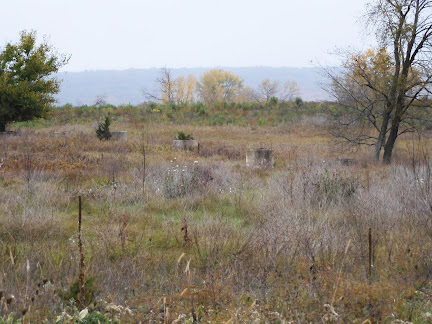
Thoelke Cemetery. The foundation of Immanuel Evangelical Church is nearby, but we never found it that day.


Pioneer Cemetery contains graves of some of the early settlers to the area, but unfortunately is on land owned by the Ho-Chunk, so this was all the closer we could get.

I hope I can go back again someday to explore more deeply.

 For more information, click on any of these links. 


When we were there, we met the man in the article. He was so knowledgeable and helpful, passionate about this site as well.  https://www.jsonline.com/story/life/green-sheet/2017/06/08/wisconsin-home-largest-munitions-plant-world-museum-reviving-its-story/374526001/

A long article, but worth the read if you want to do a deep dive, also pictures of the buildings are at the end.  https://www.jmc.army.mil/Docs/History/Badger%20Army%20Ammunition%20Plant%20-%20V3%20Internet.pdf

And what would we do without Wikipedia -  https://en.wikipedia.org/wiki/Badger_Army_Ammunition_Plant


Tuesday, February 19, 2013

The Tripoli Years


I’ve been writing this month about my father’s life. I have few artifacts from those years; the years were lean and there wasn’t much to keep. My mom has a few items, things my dad’s family picked up at second hand stores of the time. Just dawned on me that second hand stores are becoming more and more popular today; I never thought much of them being around in the thirties and forties, but it only makes sense that people would shop for cheap stuff back then too.

Anyway, here is the most prized possession I have. The ledger which my dad kept when he lived and worked on his mother’s farm in Tripoli.

There are a lot of holes in my dad’s life. His family moved from Chicago to Tripoli, Wisconsin, in 1934. My dad started keeping this ledger in 1939. Sometime in between there, rumor has it, he traveled out west via the railroad looking for whatever work was available. Yep, he was a hobo for a time, but I don’t know any more about it than that.

Sometime during those years he also worked for the Civil Conversation Corps. Don’t know much about that either, except that in much later years, he still talked about the CCC camps with deep respect.

But back to the ledger, coz that I have in writing. A few of the interesting entries included that the income for the month of January, 1939, was $17.88 and the total expenses were $21.90.  The largest portion of the budget for that month went towards groceries for a total of $7.70.   An average of 60 cents were spent a month on tobacco.  In November 1939, someone splurged and went roller-skating, buying a pop while they were there.  The total tab for that night on the town was 85 cents.

The regular monthly income came from the sale of milk. Occasionally they butchered a cow for meat but sold the hide for between two and three dollars. Once a year or so, they sold a bull; in 1940 Guy brought in $35 while in 1942 Andy sold for $80.

Can you imagine? Not quite what my budget looks like today. 


Thursday, September 6, 2012

Hopevale

This poem was written by Jennie Adams, a nurse and Baptist missionary to the Phillipines.  At the Green Lake Conference Center there is a trail through the woods along which there is a series of such signs with the entire poem she had written. At the end of that path sits Hopevale Cathedral in the Glen, a replica of the chapel where Jennie worshiped as a refuge at Paney in the Phillipines. In December 1943, she and ten other missionaries were martyred by the Japanese.
 
Wow, I would love to write up this whole story for you here, but please check out this website, for the whole story. Some day, when I have time (like that will happen any time soon), I would like to learn more about this courageous woman and those who were with her that day.